


By Shihab Oruvil
Founder & Managing Director, Seagate Properties
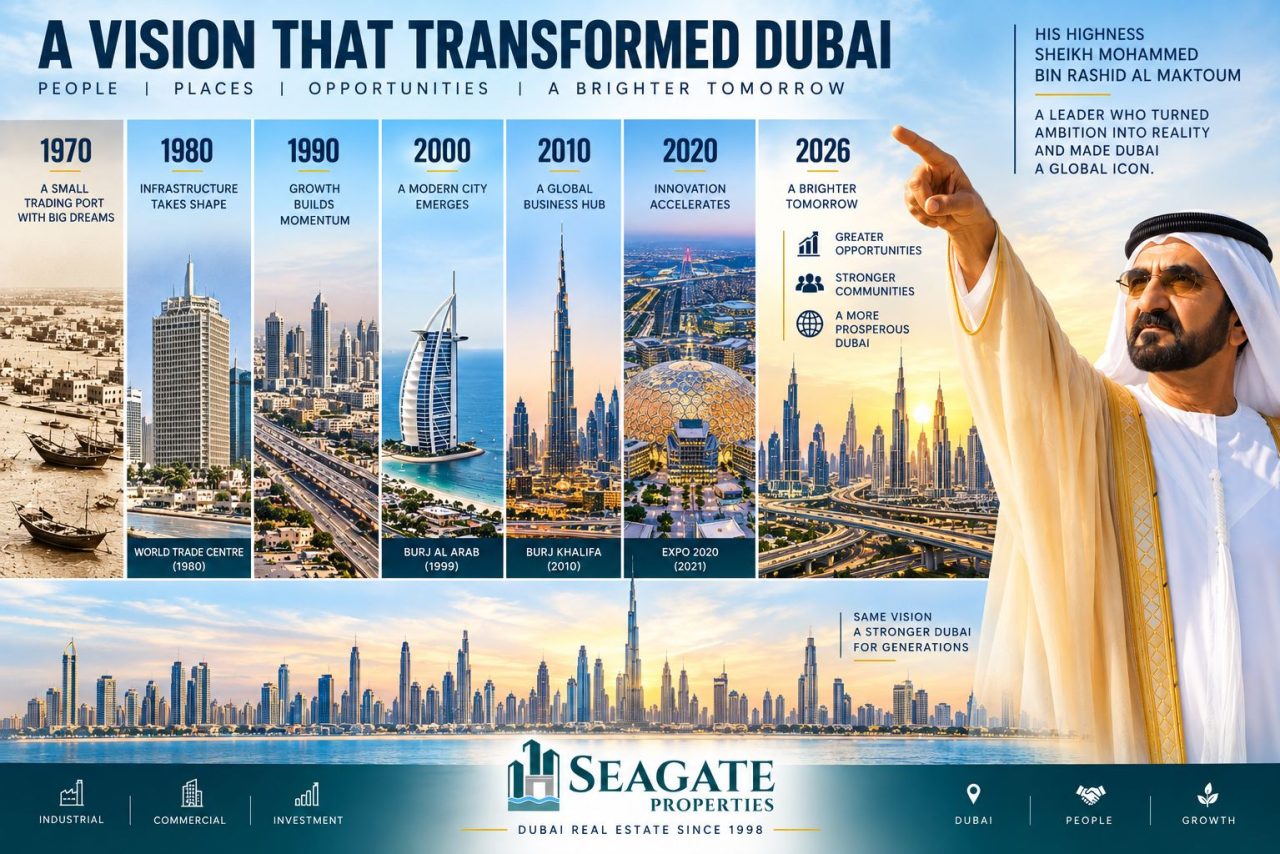
Dubai’s extraordinary transformation is not simply a story of skyscrapers, highways, luxury hotels, and record-breaking developments. It is fundamentally a story of visionary leadership, long-term planning, courage, infrastructure investment, and an unwavering belief in the future.
From a trading community centred around Dubai Creek, the emirate steadily developed into one of the world’s most recognised destinations for business, tourism, aviation, logistics, real estate, and investment. Dubai did not choose to depend solely on oil; it diversified into trade, tourism, aviation, finance, logistics, technology, and real estate.
The Dubai we see today was not created overnight. It is the result of decades of vision, decisions, challenges, lessons, and continuous improvement.
1970s–1980s: Building Before the Demand
The late Sheikh Rashid bin Saeed Al Maktoum understood something fundamental: infrastructure had to come before growth.
Roads, ports, airports, and commercial infrastructure were investments in a Dubai that did not yet exist—but which its leadership could already imagine.
The opening of the Dubai World Trade Centre in 1979 became an important symbol of this ambition and helped establish Dubai as a destination for international business, exhibitions, and trade.
This philosophy—build for tomorrow, not only for today—became part of Dubai’s DNA.
1990s–2000s: Dubai Announces Itself to the World
During the 1990s and early 2000s, Dubai accelerated its international ambitions.
Tourism, aviation, free zones, technology, and real estate became increasingly important. Projects such as Burj Al Arab demonstrated that Dubai was prepared to think differently, take calculated risks, and create landmarks capable of putting the city on the global map.
Dubai was no longer simply developing infrastructure.
It was building a global brand.
2008–2009: Learning From the Financial Crisis
Progress does not mean never facing difficulties.
The global financial crisis of 2008–2009 was a major test. Dubai’s property and construction sectors were affected, international liquidity tightened, and the UAE economy faced significant external pressures. The authorities responded with measures including liquidity support, bank recapitalisation, and deposit guarantees.
For those of us working in Dubai’s real estate sector at that time, it was an unforgettable period.
But there is an important lesson in what happened afterwards.
Dubai did not allow a crisis to define its future. It learned from it.
The market matured. Financial discipline, regulation, transparency, and risk awareness became increasingly important. The economy recovered, and Dubai continued diversifying and attracting international business.
This is one of the qualities I admire most about the UAE: when a challenge exposes a weakness, the response is to learn, strengthen, and move forward.
2010: A New Global Skyline
The opening of Burj Khalifa represented much more than the completion of the world’s tallest building.
It became an international symbol of Dubai’s ambition.
Around it emerged Downtown Dubai and a new generation of developments that strengthened the emirate’s appeal to international investors, businesses, tourists, and residents.
Dubai demonstrated an important principle:
Vision creates confidence.
Confidence attracts investment.
Investment creates opportunity.
COVID-19: Leadership Is Tested During Difficult Times
Then came COVID-19.
The pandemic challenged virtually every government, healthcare system, economy, and business community in the world.
The UAE entered the pandemic with an integrated national emergency-management structure, and its response included national coordination, risk assessment, surveillance, and measures to strengthen its ability to detect health threats.
For me, the most important lesson was not simply how the country responded to COVID-19.
It was how it learned from the experience.
Every major crisis provides knowledge about what must be strengthened for the future. The UAE today carries the institutional experience gained from managing one of the greatest global health emergencies of modern times.
We cannot say that any country can guarantee that another pandemic will never cause disruption. But we can say something important:
Experience creates preparedness.
That is the UAE approach—learn from yesterday and prepare for tomorrow.
My Personal Experience During COVID-19
During COVID-19, I volunteered day and night, delivering medicines to people in quarantine and supporting families in need. I also assisted with the respectful handling and burial of those who passed away.
This experience showed me firsthand the strength of the UAE—strong leadership, quick action, community unity, and humanity during the most difficult times.
Expo 2020: Bringing the World Together
After an extraordinarily difficult period for the world, Expo 2020 Dubai became another demonstration of Dubai’s confidence and international outlook.
It represented connection, innovation, and optimism about the future.
Dubai continued investing in technology, sustainability, digital transformation, advanced infrastructure, and quality of life.
The message was clear:
Dubai’s ambition does not stop because the world faces uncertainty.
The 2024 Rainfall: Turning a Challenge Into Infrastructure
Another example came with the exceptional rainfall and flooding in April 2024.
Again, the important story is not simply that Dubai faced a challenge. Every major city faces unexpected natural events.
What matters is what happens afterwards.
Dubai responded by advancing major improvements to its rainwater drainage infrastructure. This reflects the same philosophy we have seen repeatedly:
Identify the problem.
Study the experience.
Improve the system.
Prepare for the future.
That mindset is more valuable than pretending challenges will never occur.
2026 and Beyond: Always Another Target
Under His Highness Sheikh Mohammed bin Rashid Al Maktoum, Dubai continues to plan decades ahead.
The Dubai Economic Agenda D33 aims to double the size of Dubai’s economy over a decade and strengthen its position among the world’s leading global cities.
The Dubai 2040 Urban Master Plan looks even further ahead—toward sustainable communities, mobility, infrastructure, quality of life, and economic opportunity.
That tells us something fundamental about Dubai:
There is always another target ahead.
What I Have Personally Learned Since 1998
Having worked in Dubai’s real estate sector since 1998, I have been fortunate to witness a remarkable part of this journey.
I have seen areas that once appeared distant become major communities.
I have seen empty land become business districts.
I have watched new highways completely change the value and accessibility of locations.
I have seen industrial areas evolve into sophisticated manufacturing, warehousing, and logistics hubs.
I have watched free zones attract businesses, entrepreneurs, and investment from around the world.
And I have experienced different market cycles—the extraordinary growth, the global financial crisis, the recovery, COVID-19, and another period of remarkable expansion.
These experiences taught me something:
Dubai’s real strength is not that it never faces challenges. Its strength is how quickly it learns from them.
A successful city must be able to correct, adapt, and prepare.
That is what Dubai repeatedly demonstrates.
Visionary Leadership: The Strength and Trust of the UAE
Buildings alone cannot create a successful country.
Money alone cannot create confidence.
Infrastructure alone cannot create a society where people from across the world choose to live, work, invest, and raise their families.
Leadership creates that confidence.
The visionary leaders of the UAE are a source of its strength, stability, and trust. Their ability to think beyond the present, learn from experience, and prepare for challenges before they arrive has helped create confidence among citizens, residents, businesses, and investors.
Dubai’s leaders have built infrastructure before demand fully arrived. They welcomed international talent and investment. They encouraged entrepreneurship. They embraced technology. They took calculated risks. And after difficult experiences, they improved systems rather than standing still.
That is why Dubai’s development should never be measured only by Burj Khalifa, Burj Al Arab, Expo City, highways, airports, ports, or billions of dirhams in real estate transactions.
Its greatest achievement is the opportunity it has created for millions of people.
People arrived here with dreams.
Workers built careers. Entrepreneurs established businesses. Families created futures. Investors found opportunities. Companies from across the world made Dubai their regional and global base.
From the Dubai Creek of yesterday to the global metropolis of today, the transformation has been extraordinary.
But after nearly three decades of witnessing Dubai’s development, I believe something even more strongly:
Dubai’s greatest achievement may not yet have been built.
Because here, every achievement becomes the foundation for the next ambition, every challenge becomes a lesson, and every generation is encouraged to dream bigger than the one before it.
The journey is still continuing.
Shihab Oruvil
Founder & Managing Director
Seagate Properties
Dubai Real Estate Since 1998

Leave a Reply